
Torque Specs for Accessory Drive Systems: How Tight Is Tight Enough?
How Much Torque Do I Use?
When it comes to working on your engine's accessory drive, one of the most common questions we get is: how much torque should I use when tightening bolts? No, we're not talking about how many foot pounds you're putting to the ground — we're talking about how much force to use when tightening hardware on your accessory drive system.
There are certain areas in an automotive application where a recommended torque value is critically important — head bolts and connecting rod cap bolts are prime examples. But when it comes to an accessory drive system, it's much less vital to hit a precise torque figure. That said, there's still a right way and a wrong way to do it.
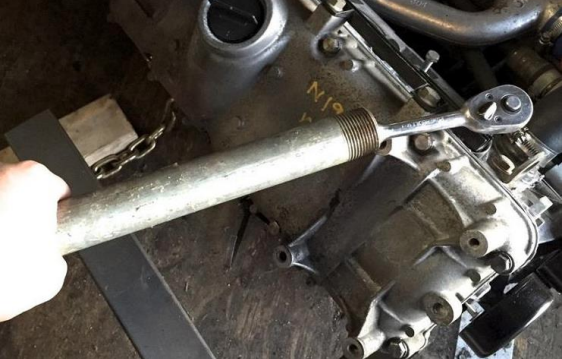
Tight vs. "Farmer Tight"
There is a huge difference between tight and what we here in Minnesota refer to as "farmer tight." Tight means seating the bolt firmly using a normal tool — a box end wrench or a 3/8" drive socket. "Farmer tight" is brute force with the same tools plus a 3-foot pipe slipped over the handle for extra leverage. One seats the bolt properly. The other can snap it off inside your block.
Why Torque Matters More on Modern Engines
Originally, vehicles had cast iron blocks and steel brackets with very little give. Nowadays, most engine components — including CVF Racing's billet aluminum brackets and accessories — are aluminum. Aluminum is a softer metal, which means you need to be more careful. The risks are:
- Too much torque: You risk pulling threads or snapping the bolt off inside the block or head — a much bigger headache than any loose bolt.
- Too little torque: You may end up with rattles or minor leaks, but those are easily fixed by simply snugging the bolt down.
The bottom line: err on the side of "tight but not crazy tight." Snapped bolts inside aluminum blocks are no fun to deal with.
CVF Racing Recommended Torque Values
Since we use Fastenal hardware on all of our CVF Racing kits, we follow the same torque specifications they recommend. Below is our torque spec chart for SAE hardware commonly used in accessory drive applications. Use this as your guide when installing your CVF serpentine kit, brackets, pulleys, or related accessories.
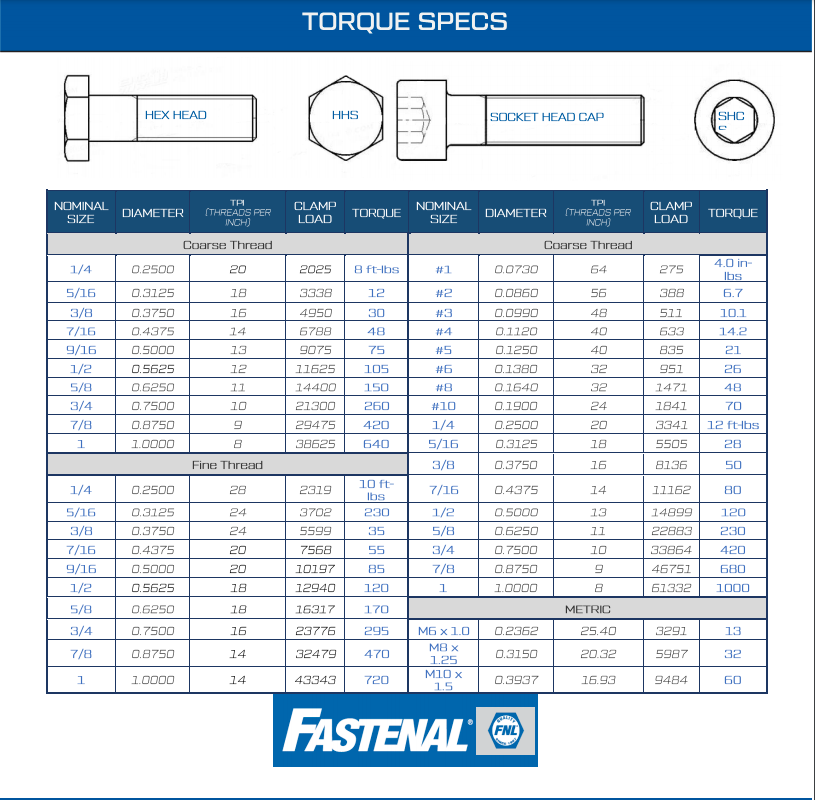
Note: Always verify torque specs against the specific fastener grade and material you are working with. When in doubt, call our free tech support line at 651.356.8593.
General Tips
- Use a quality 3/8" drive torque wrench for most accessory drive fasteners.
- Apply a small amount of thread lubricant (like anti-seize) on stainless bolts going into aluminum to prevent galling.
- Re-check torque after the first heat cycle on a freshly built engine.
- When in doubt, call CVF Racing's free tech support team — we're here to help!
Recent Posts
-
Chevy LS Intake Manifold Clearance Issues: How to Fix Them
Swapping in a large performance intake manifold — like the Fast 102mm — on a Chevy LS engine is a po …Mar 3rd 2026 -
What is VVT and Do I Have It? (Chevy LS Guide)
If you're building or swapping a Chevy LS engine, one of the first things you need to determine is w …Feb 25th 2026 -
Hot Rod Bio: 1,500 Horsepower on pump gas - Anthony’s ProCharged 1970 Chevelle
At SEMA 2025 we caught up with Anthony and his 1970 Chevelle that makes a very casual 1,500 horsepo …Jan 23rd 2026