
Why my kit won’t line up: balancers, water pumps and spacers
General Information
Every CVF bracket system is built around a particular water pump and a particular harmonic balancer. Change either one, or reuse accessories from an engine that was built across several production years, and the whole accessory drive plane moves with it.
Overview
Short Answer
On our Wraptor and Reaper systems the brackets mount to and locate off the water pump, so the pump is effectively the base of the kit. We also build brackets that do not mount to the water pump at all. Either way, the harmonic balancer sets where the crank pulley sits. If the pump or the balancer differs from what your kit was built around, the belt plane shifts and the brackets may need shimming, or the combination may not work. On a serpentine conversion kit or a set of our V-belt pulleys and brackets you are adding our parts to accessories you already own, so every carried-over component is another variable. Tell us what you are running before you order.
Where your kit locates from
On our Wraptor and Reaper systems, the brackets mount to the water pump and the pulleys are spaced from it. A pump that differs from the one the kit was designed around therefore puts every bracket and pulley out of position, and it does that before you have made a single mistake in the install. Not every CVF bracket works that way, though. We also build brackets that do not mount to the water pump, so if you are not sure which you have, send us your order number and we will tell you.
A difference in how far the hub stands off the pump can often be made up with a spacer. On a system that mounts to the pump, a difference in the shape of the casting cannot, because that moves the bracket mounting points rather than just the pulley. That is the case that ends in shimming or trimming.
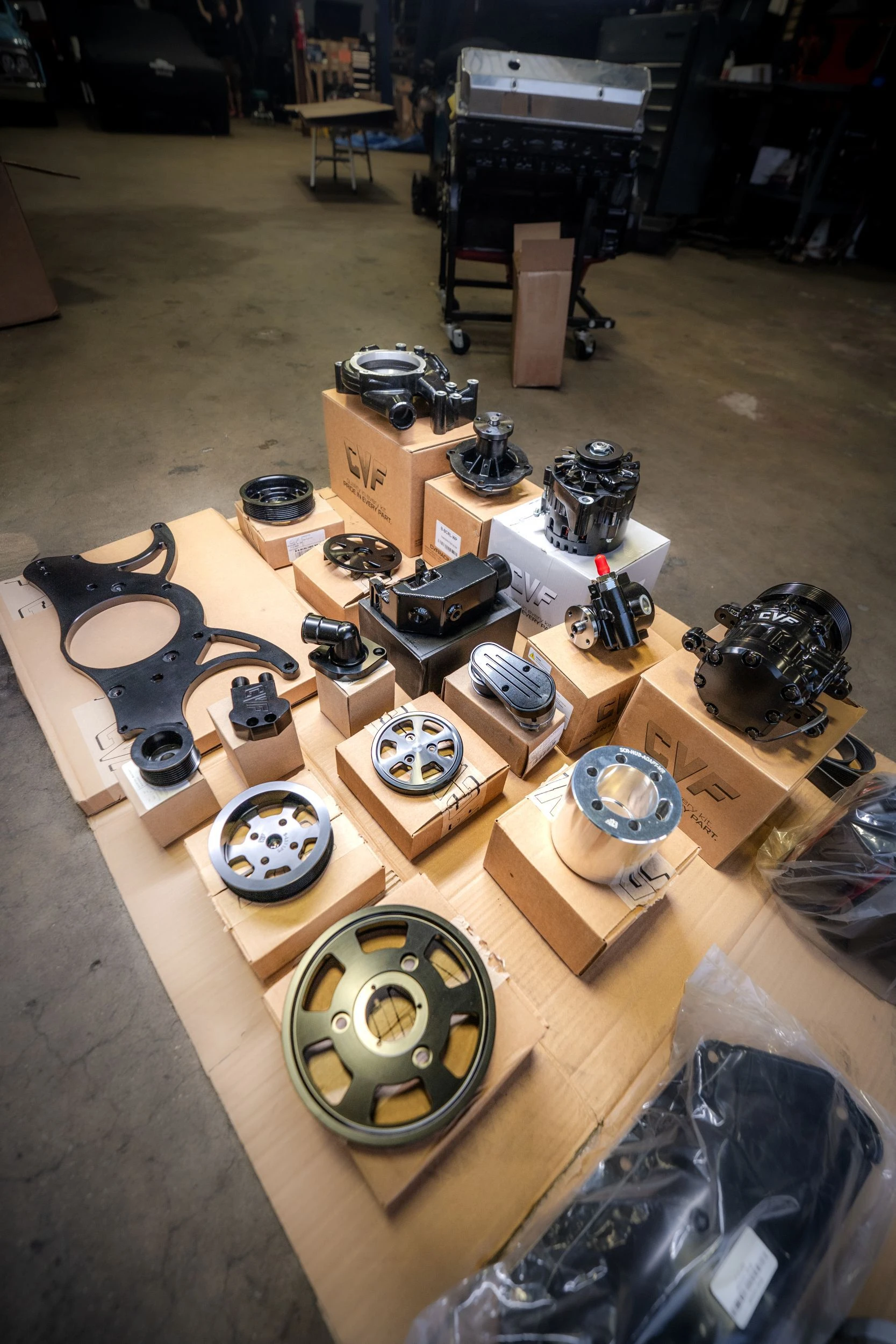
A Wraptor kit as it ships. Several components, not one engraved bracket, which is why a single part will not identify a kit.
The balancer sets the crank pulley
The harmonic balancer determines both where the crank pulley sits fore and aft, and how it mounts. Kits are configured for the balancer the system was developed with, and a different balancer can change either of those.
Because balancer patterns vary between engine families and between manufacturers, this is not something to work out from a catalogue photo. Send us what you have and we will confirm it against your kit.
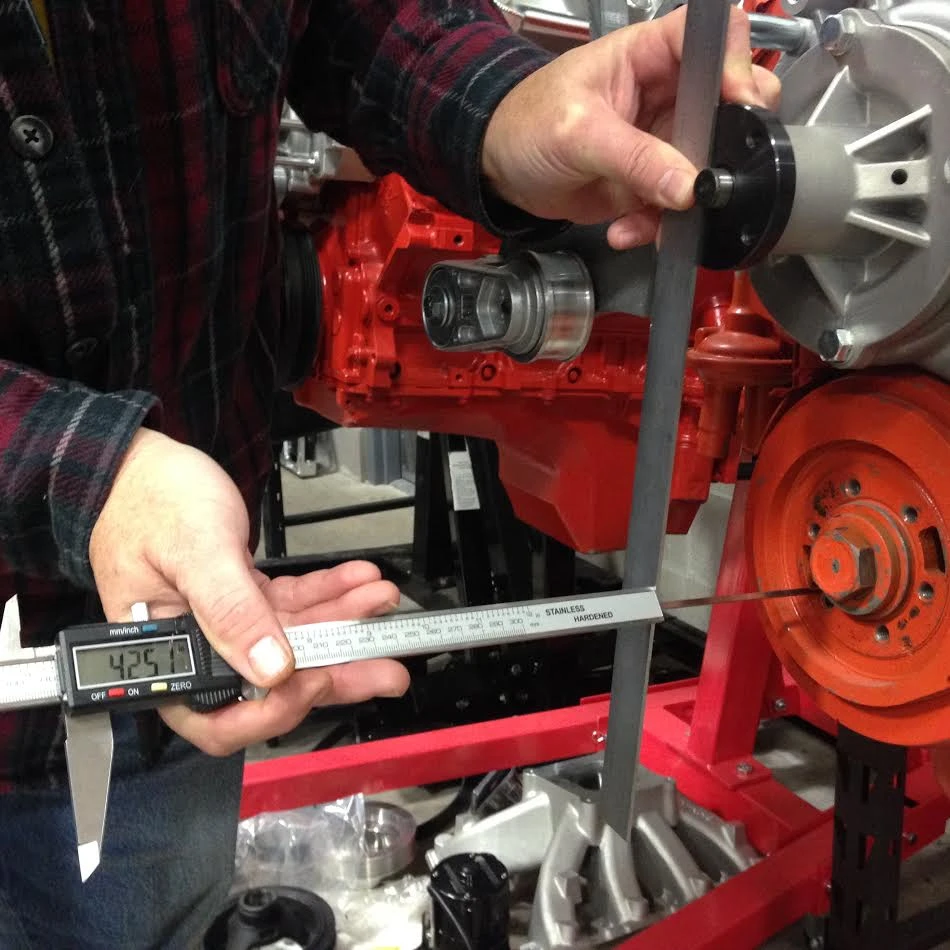
The measurement we ask for: the horizontal distance between the two pulley mounting surfaces.
Reusing your own accessories stacks up tolerances
Everything above assumes a complete system. A serpentine conversion kit, or a set of our V-belt pulleys and brackets, is a different situation: you are not replacing the whole accessory drive, you are adding CVF parts to accessories, brackets, pulleys and a balancer you already own. That is where most alignment problems actually come from.
An accessory drive is a stack of tolerances measured off the block face. Each component in the chain — the balancer, the water pump, the spacers, the bracket, the pulley hub — contributes its own offset, and the belt only tracks when every one of those offsets lands in the same plane. Get one component from a different production year or a different manufacturer and its offset differs from the one the rest of the stack was built around. Nothing is defective. The plane has simply moved.
This matters more than people expect because the engine families we build for ran for decades. Over that span the same nominal engine went through multiple water pump heights and shaft lengths, more than one balancer thickness and bolt pattern, and several factory bracket designs, sometimes changing with options like air conditioning or the emissions equipment fitted that year. A part that physically bolts on is not automatically in the same plane as the part it replaced, and a reused accessory carries whatever offset it was designed around into your stack.
The practical version: the more of the drive that comes from one system, the fewer variables there are. If you are mixing, treat every carried-over component as an unknown until it is measured. The pulley face measurement in the previous section is what resolves it, because it tells us where your plane actually sits rather than where the parts catalogue says it should.
Before you order, tell us what you have
- the engine, including any block or head changes that affect accessory mounting
- the harmonic balancer make and model
- the water pump make and part number, if it is not ours
Two minutes of this up front saves a kit sitting on the bench while parts get sorted out. If you bought through eBay or Amazon we cannot reconfigure a kit against a marketplace listing, so ordering direct from cvfracing.com is the way to get a kit matched to your combination.
If you are already assembled and the belt won’t track
Check spacer placement first. Every spacer supplied, in the right position, none doubled up or left in the box.
Lay a straightedge across the pulley faces to find which pulley is out of plane.
Send us photos taken straight on, with your order number.
See our article on belts that keep coming off for the full alignment procedure.
Watch it on video
That face measurement is what decides where the crank pulley ends up.
Water Pump to Crank Pulley Face Measurement — CVF Racing on YouTube
Still need help? Our tech support team can get you pointed in the right direction.
Contact Support