
How do I wire a one wire alternator?
Alternators
One wire alternators are the simplest part of a serpentine conversion, and the most common source of unnecessary worry.
Overview
Short Answer
No plug harness is needed. A one wire alternator self excites, so the only connection is a single charge wire from the output stud on the back of the alternator to battery positive, or to the starter solenoid battery post. Any factory plug can be left unplugged and taped off.
The whole installation
Run one appropriately sized charge wire from the output stud on the back of the alternator to battery positive, or to the battery post on the starter solenoid.
Leave any factory plug unplugged. Tape it off so it cannot rub or short.
That is it. There is no exciter wire, no ignition trigger, and no harness to source.
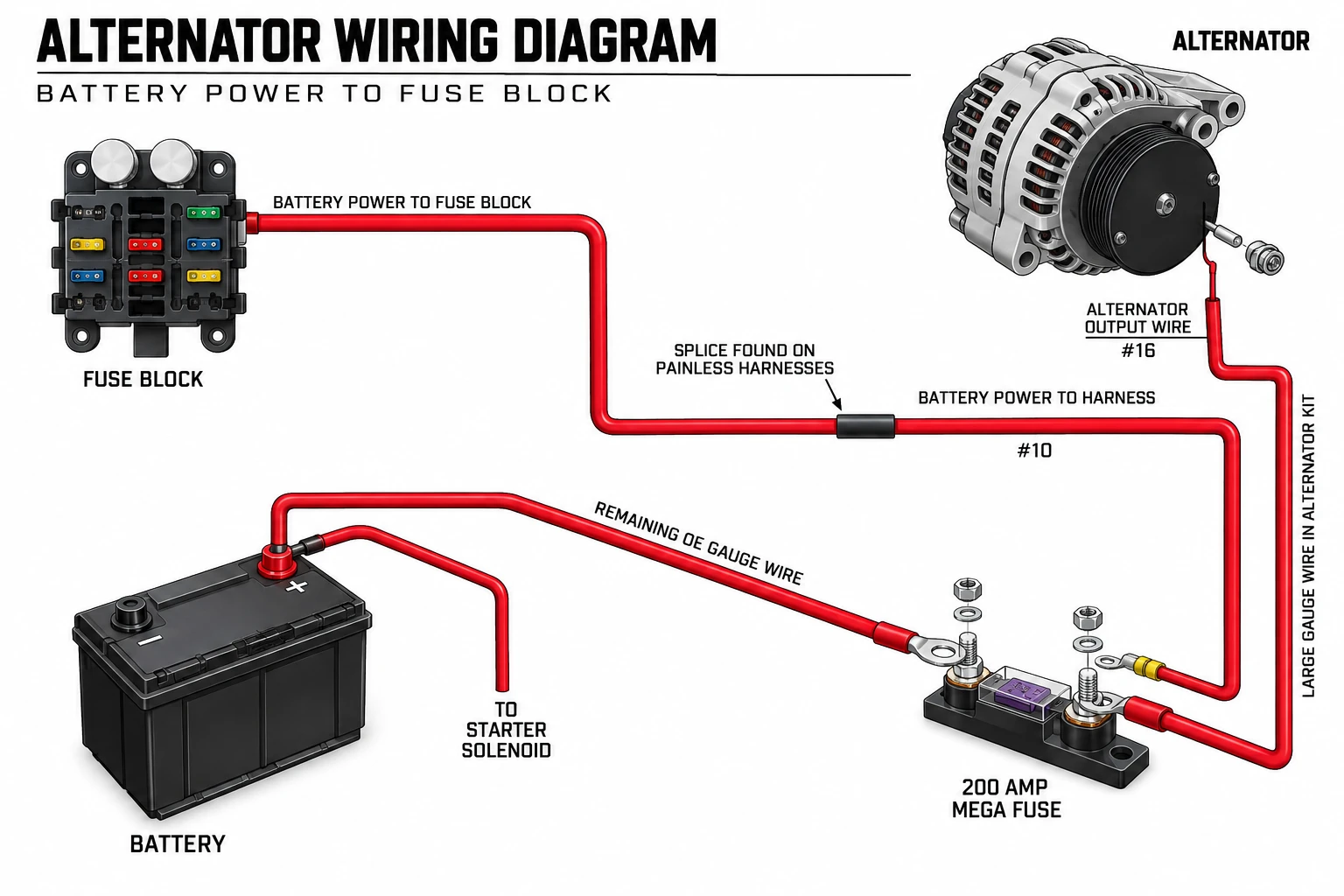
How the charge wire routes: alternator output through a 200 amp mega fuse to the battery, with battery power to the fuse block.
What self exciting means
A conventional alternator needs a small voltage fed to its regulator to start charging. A one wire unit has an internal regulator that senses shaft speed and begins charging on its own once it is spinning fast enough, which is why it needs no external trigger and no plug.
One thing to be aware of
Because a one wire alternator has no separate sense wire, it regulates based on voltage at its own output stud. Keep the charge wire as short as the routing allows, sized properly for the alternator’s output, and well terminated at both ends.
No dash light
A one wire setup does not drive a factory charge warning lamp, since there is no field terminal for the lamp circuit to reference. If you want a working charge light, you need an alternator with the appropriate terminal.
If it is not charging
A one wire alternator that will not charge is usually being let down by what is around it rather than by the alternator itself. Work through these in order.
The charge wire is too small. One wire alternators are more sensitive to wire size than an externally regulated unit. If there is too much voltage drop between the alternator and the battery, the internal regulator gets a false reading and the alternator will not charge. In many cases the OEM wiring is not sufficient. Use pure copper, not copper clad aluminum.
| Alternator output | Up to 10' | 10' - 13' | 14' - 16' | 17' - 22' | 23' - 28' |
|---|---|---|---|---|---|
| 75 - 125 AMP | 6 | 4 | 2 | 2 | 1/0 |
| 125 - 175 AMP | 4 | 2 | 2 | 1/0 | 1/0 |
| 175 - 225 AMP | 4 | 2 | 1/0 | 1/0 | 2/0 |
| 225 - 300 AMP | 2 | 1/0 | 2/0 | 2/0 | 3/0 |
| 300 - 350 AMP | 2 | 1/0 | 2/0 | 3/0 | 4/0 |
The case is not grounded. Paint and corrosion can stop the alternator grounding through the alternator housing, bracket and engine path. Run a separate ground wire of the same size as the positive so the alternator is properly grounded.
The pulley ratio is too low. A one wire unit switches itself on off shaft speed, so if it is not spinning fast enough it will not come on at idle. Bring the engine up off idle and see whether it starts charging.
The terminals are loose or over torqued. Recommended torque at the wiring terminals is 65 in-lbs, which is 5.4 ft-lbs. Do not over torque them.
Have it bench tested. If the wire size, ground and pulley ratio all check out, take the alternator to a local parts store and have it bench tested. Most of them do it at no charge. That is what separates a unit that has actually failed from an install that is holding it back, and it is the result we need before we can move on a replacement.
Fuse protection
CVF recommends fuse protection between the battery and the alternator on all one wire alternators. Minimum fuse size is 250 AMP. For alternators larger than 250 AMP, use a 400 AMP fuse.
Before you start
Disconnect the negative cable from the battery before doing any of this. Not doing so can short out electrical equipment while you work. If you would rather not work the wiring out yourself, CVF offers a high amp wiring kit under part number 30700. You can also see our full range of one wire alternators.
Still need help? Our tech support team can get you pointed in the right direction.
Contact Support