
Single-Belt vs. Dual-Belt Supercharger Drives: Which Do You Need?
CVF Racing / Supercharger Drive Guide
Single-Belt vs. Dual-Belt Supercharger Drives: Which Do You Need?
Building a supercharged street car or chasing four-digit horsepower? Your front-drive system should match the job. The right choice starts with your supercharger, boost goals, and available space.
For compatible applications, a single-belt Wraptor is a strong choice for a milder boosted build. When big boost and four-digit horsepower are the goal, start with the Reaper's dedicated supercharger drive. Here's how the layouts differ—and where ProCharger and traditional cog-belt blower systems fit into the picture.
The Quick Recommendation
Milder boost and a strong street performer? Consider a compatible single-belt Wraptor.
Big boost and four-digit horsepower goals? Consider a compatible dual-belt Reaper.
These are selection guidelines, not fixed horsepower limits. Your exact engine, blower, pulley combination, and intended use determine the right system.
Single-Belt Example
Supercharged Wraptor

One 8-rib serpentine belt drives the supercharger and accessories in the LSA example shown here.
View LSA Wraptor ExampleDual-Belt Example
Supercharged Reaper
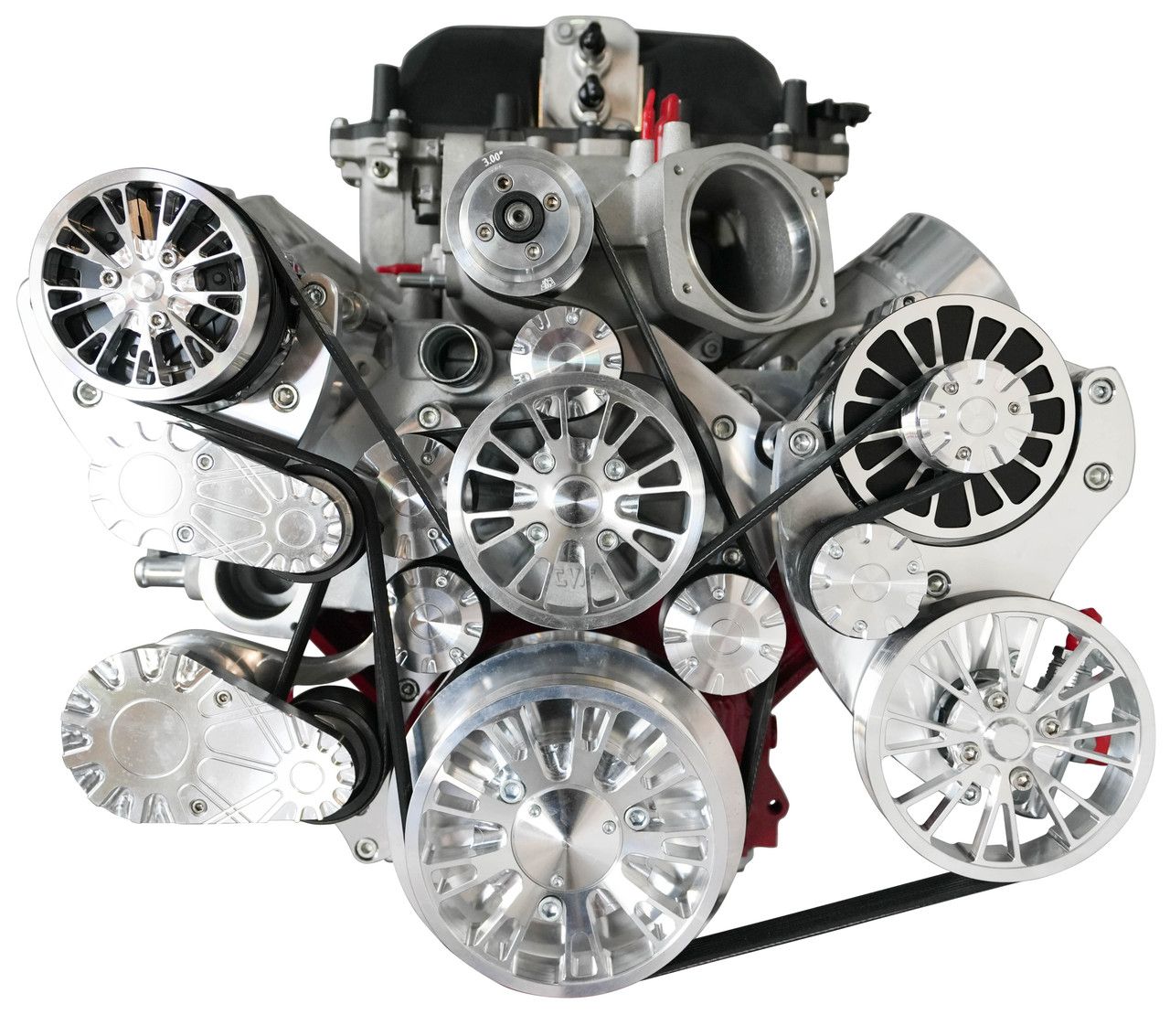
A dedicated 10-rib belt drives the supercharger while a separate 8-rib belt handles the accessories.
View LSA Reaper ExampleLSA systems are pictured to illustrate the layouts. CVF offers supercharged drive options across Chevy LS, Chevy LT, and Gen III Hemi applications. Availability and belt layout depend on the exact engine and supercharger combination.
What Changes with Two Belts?
In a single-belt supercharger system, the blower and accessories share a belt. It's an integrated layout that can work well for a milder boosted combination when the system is matched to the application.
The supercharged Reaper separates those jobs. Its 10-rib blower belt is dedicated to driving the supercharger, while the 8-rib accessory belt operates independently. That dedicated, wider blower drive is the reason to consider Reaper as boost and power goals increase.
| Consideration | Single-Belt Wraptor | Dual-Belt Reaper |
|---|---|---|
| Belt layout | Shared supercharger and accessory belt | Separate supercharger and accessory belts |
| LSA examples shown | One 8-rib belt | 10-rib blower belt and 8-rib accessory belt |
| Build direction | Milder boost and strong street performance | Big boost and four-digit horsepower goals |
| Before ordering | Confirm blower compatibility, pulley selection, and clearance | Confirm blower compatibility, balancer requirements, and clearance |
Choose for the Build You're Planning
For a street-focused build with milder boost goals, a compatible single-belt Wraptor provides an integrated supercharger and accessory drive without stepping into a dedicated Reaper blower-drive layout.
If the plan includes big boost and four-digit horsepower, start the conversation with Reaper. Consider your future plans as well as the current combination, then confirm the system with CVF before choosing the kit and pulleys.
There isn't one boost or horsepower number that decides every application. The engine, supercharger, pulley combination, and intended use all matter. Treat the mild-build versus big-boost recommendation as a starting point for selecting the correct drive.
Check the Space First
Belt count alone doesn't tell you whether a system will fit. Compare the dimensional drawing for the exact kit with your available engine-bay space. Check radiator and fan clearance, accessory positions, suspension clearance, and the required balancer and water pump combination.


Know Your Blower Layout
ProCharger Wraptor Systems Also Use Two Belts
Wraptor doesn't always mean single-belt. CVF's centrifugal supercharger Wraptor systems for compatible Chevy LS, small-block Chevy, and big-block Chevy applications use a dedicated 10-rib ProCharger drive alongside a separate accessory belt. Select by the specific engine and blower application rather than assuming every Wraptor shares the layout pictured above.
Traditional Cog-Belt Blowers Are a Separate Arrangement
Traditional external-drive Roots-style blower setups, such as 6-71 and 8-71 combinations, use a separate cog belt for the supercharger. That blower drive operates separately from the accessory serpentine system, with the crank cog pulley forming the connection at the crankshaft. These applications require their own drive and clearance planning.
What to Have Ready Before You Order
- Your exact engine and supercharger model
- Current boost and horsepower goals, plus planned upgrades
- Street, track, or mixed-use plans
- Balancer, water pump, and intake details
- Required accessories: alternator, power steering, and air conditioning
- Available clearance around the front drive and accessories
CVF offers application-specific systems across multiple engine and blower combinations. Review the complete kit contents and application notes before ordering; requirements such as balancers, plumbing, thermostat housings, and electric fans vary by kit.
CVF Racing / Build Around Your Goals
Choose the Drive That Fits Your Build.
From a mild boosted street combination to a big-boost project, we'll help you match the system to your engine, supercharger, and available space.
Call 651-356-8593 to discuss your combination.
Recent Posts
-
Single-Belt vs. Dual-Belt Supercharger Drives: Which Do You Need?
CVF Racing / Supercharger Drive Guide Single-Belt vs. Dual-Belt Supercharger Drives: Which Do You …Oct 26th 2026 -
CVF Billet Hood Hinges for 1972–1993 Dodge Trucks
CVF Racing / New Products Billet Hood Hinges for 1972–1993 Dodge Trucks Bring smooth hood operatio …Sep 28th 2026 -
CVF Racing Introduces Billet Aluminum Valve Cover Kit for LS Engines
CVF Racing / New Products Introducing CVF Billet LS Valve Covers Give your LS build a billet finis …Aug 26th 2026