
Power Steering Reservoirs and AN Line Kits
Power Steering
Whether your reservoir bolts to the pump or lives somewhere else in the engine bay, the plumbing rules are the same. Here is what goes where, what is in our line kits, and how to assemble the hose ends yourself.
Overview
Short Answer
A remote reservoir is used when a pump mounted one will not fit. Mount it anywhere in the engine bay as long as the hose runs downhill to the pump, and use -10AN or 5/8" for the feed from the reservoir to the pump. The high pressure line from the pump to the box is -6AN PTFE. The return from the box back to the reservoir is regular -6AN. Our line kits include all of it.
Pump mounted or remote
A remote reservoir is used when a pump mounted one will not fit, usually because of clearance with the frame, the control arms or the steering components. If a pump mounted reservoir clears everything on your car, there is no reason to go remote.
If you are going remote, you can mount it anywhere in the engine bay. Common spots are the core support, the firewall and the inner fender. The one rule that is not optional is that the hose has to run downhill to the pump. The fittings on the bottom of the reservoir need to sit above the fittings on the power steering pump.
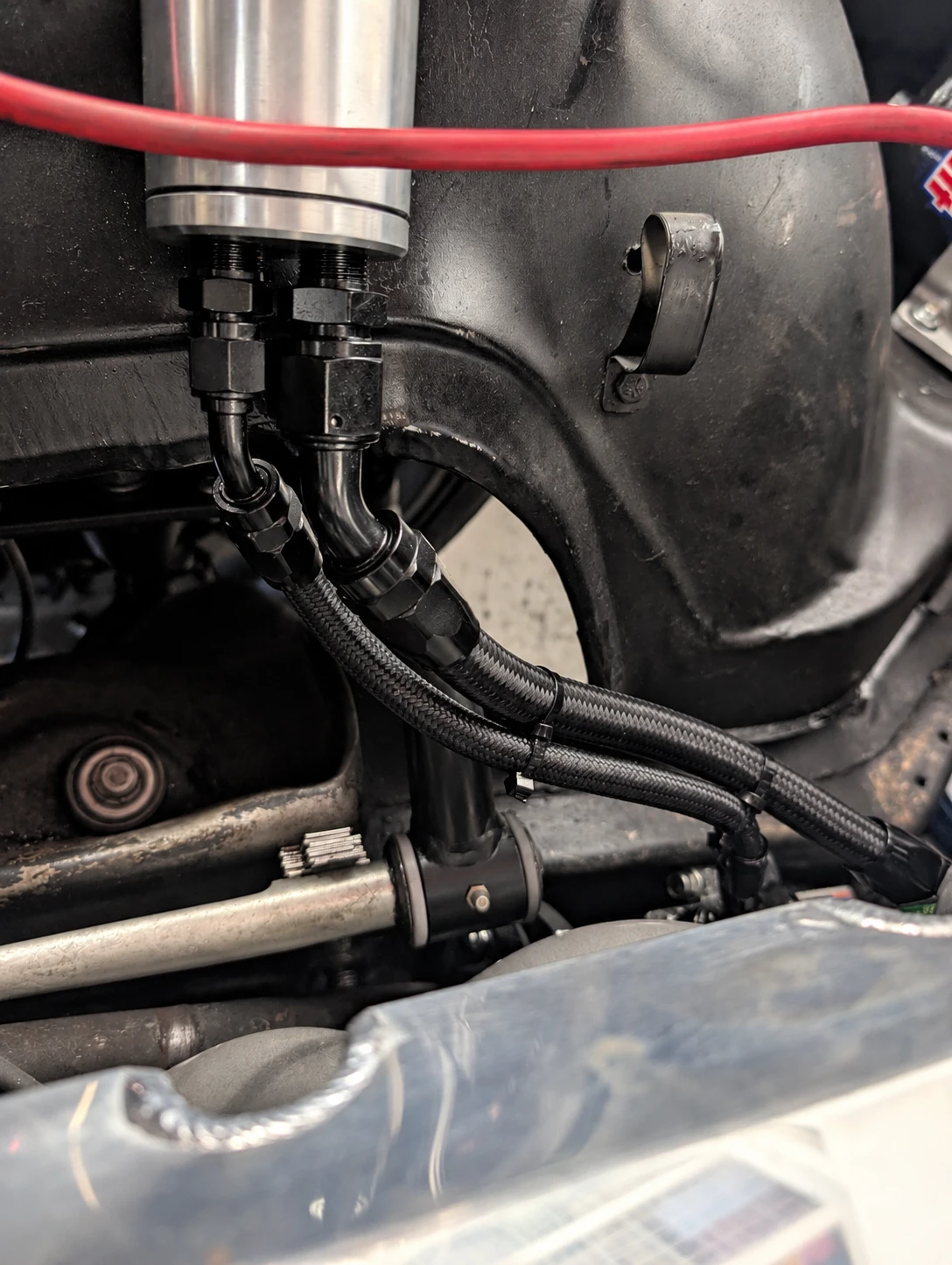
A remote reservoir mounted on the inner fender, with both hoses running downhill to the pump.
Line sizes
Three runs, three different jobs, and they are not interchangeable.
- Pump to gear box is the high pressure side. This is -6AN PTFE hose, rated for roughly 2000 psi and up. PTFE hose has a plastic liner and uses three piece hose ends.
- Gear box back to the reservoir is the return. This is regular -6AN braided hose, the lower pressure type, rated for about 250 psi or less. It has a rubber interior, no liner, and two piece hose ends.
- Remote reservoir to power steering pump line. This is the one most people get wrong. No hose smaller than -10AN or 5/8" can be used here. Do not reduce the hose size below that. This can cause the pump to starve and lead to poor performance, noise and total pump failure.
What is in a CVF power steering line kit
Every line kit includes the hose, the hose ends and the adapters for all three runs. You assemble the hose ends yourself, which is what lets you cut each run to the length your car actually needs.
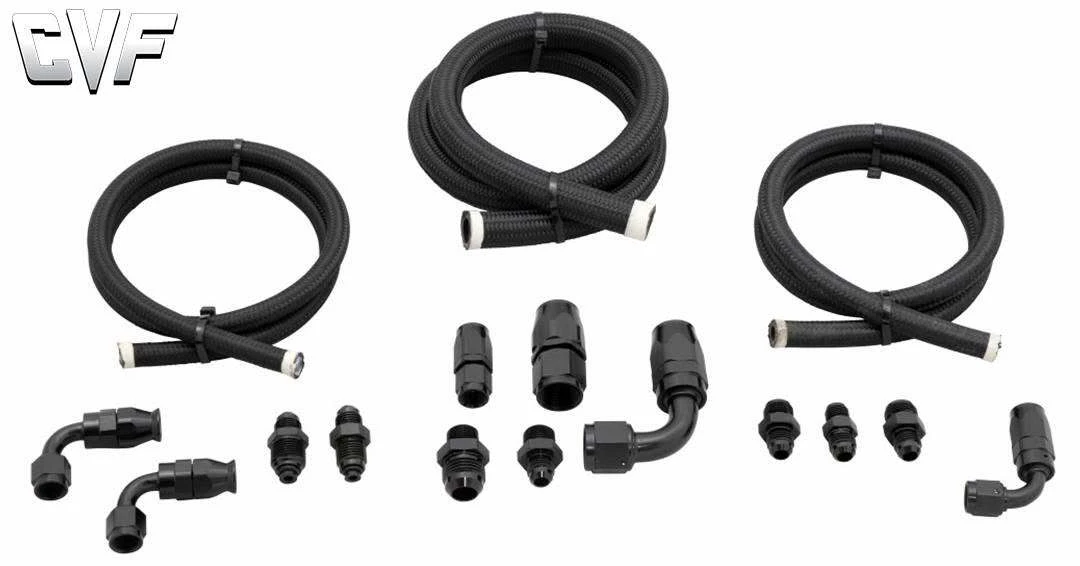
A line kit as it ships: three hoses, one for each run, with the hose ends and adapters that go with them.
| Run | What is included |
|---|---|
| Pump to gear box | 3 foot -6AN stainless steel high pressure PTFE hose; -6AN 90 degree hose end (qty 2); -6AN to 11/16-18 inverted flare adapter; -6AN to 18mm x 1.5 O-ring adapter |
| Gear box to reservoir | 3 foot -6AN stainless steel high pressure braided hose; -6AN 90 degree hose end; -6AN straight hose end; -6AN to 5/8 inverted flare adapter; -6AN to 16mm x 1.5 O-ring adapter; -6AN to 3/8 NPT adapter fitting |
| Reservoir to pump | 3 foot -10AN stainless steel braided hose; -10AN straight hose end; -10AN 90 degree hose end |
Building a PTFE hose, the high pressure side
PTFE hose ends are three pieces. The middle piece is where most people go wrong.
Slide the socket over the hose end.
Seat the olive. This is the piece causing the problem if you have tried this before and failed. It is an olive, not a ferrule and not a crush sleeve. Think of it as a wedge that goes between the PTFE liner and the steel braid. Press it into a table top to seat it all the way.
Lube the threads and the tip of the hose end, then thread them together by hand.
Hold that end in a vise and tighten with a wrench. Hold the line with upward pressure while you tighten the ends together. Once the threaded ends bottom out you are done. The corners usually align, but not always.
Repeat on the opposite end after you have decided on your length.
Building a low pressure hose, the return side
Low pressure hose ends are two pieces, no olive.
Start with a clean cut hose end. Our hoses come cut and taped on both ends, so use that to your advantage.
Twist the socket on until it bottoms out. Once it is started, pounding it on a table top is a good way to bottom it out.
Hold the socket end in a vise. Nonmarring tools are nice but not necessary.
Lubricate the threads and the inside of the hose for ease of assembly.
Thread the hose end in by hand as far as you can, then finish with a wrench. Follow the same steps on the opposite end.
Cutting to length
Make the hose from the pump to the steering rack much longer than you think it needs to be. There are two reasons for the extra length: freedom of movement, which reduces stress at the connection, and noise. This is why factory power steering lines are much longer than they need to be.
To cut, tightly wrap painters tape where you want the cut, two rounds. Mark it and cut leaving a little extra so the braid does not flare or the hose does not fray. Use a cut off wheel or hose cutters.
Flush before you install
Once both hose ends are on, flush the hose to remove any debris before final installation. Debris from cutting is a fast way to damage a new pump.
Mounting a remote reservoir
Mount the bracket at a maximum 30 degree angle, and do not block the vent hole. The baffle installs into the bottom cap on the return side. The full assembly instructions, including the parts list and the O-ring and set screw steps, are in the Remote Power Steering Reservoir instructions (PDF).
Watch it on video
Remote reservoir basics, the GM Type 2 reservoir install, and both hose builds.
Power Steering Pump Remote Reservoirs — CVF Racing on YouTube
GM Type 2 Reservoir Install Made Easy — CVF Racing on YouTube
How to Make PTFE -AN Lines — CVF Racing on YouTube
How to Make -AN Lines — CVF Racing on YouTube
Still need help? Our tech support team can get you pointed in the right direction.
Contact Support