
My hood won’t stay up, or the struts feel too strong
Hood Hinges
Strut power is the one part of a hinge kit that depends on your car rather than on the hinge. Hood weight and even your climate change how the struts behave.
Overview
Short Answer
Our struts are tested before they ship, but an aftermarket hood or a different climate can change how they work on your car. Test the first close carefully, and if the power is not right for your hood, we will work with you on an exchange for a different power.
Why strut power varies
A gas strut works on pressurized gas, so its effective force changes with temperature. A set that feels right in a warm shop can feel different outside in February.
Hood weight is the other variable. Our struts are tested against the hood the kit was developed for, so a hood that weighs more or less, whether that is fiberglass, a cowl hood, or a steel hood with a scoop added, changes what the same strut does. This is why we ask about your hood rather than assuming.
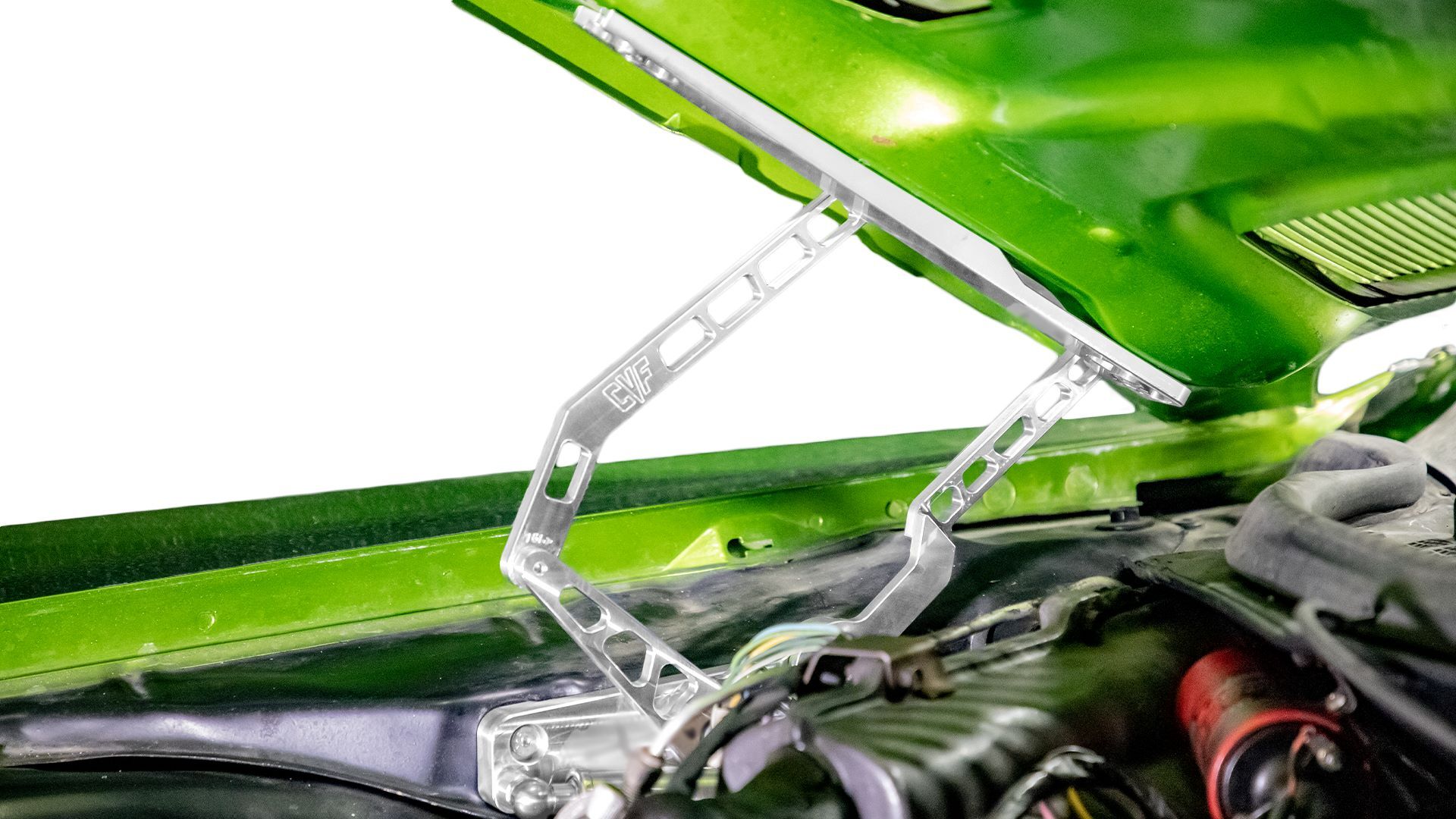
A correctly set up hinge holding the hood open. Strut power is what keeps it there.
Test the very first close carefully
Do not find out how the struts behave by letting the hood go. Ease it down by hand the first time and note what it wants to do:
| What you notice | What it means |
|---|---|
| The hood will not stay up, or drifts down on its own | Struts are underpowered for your hood |
| The hood fights you closing, or pops back up | Struts are overpowered for your hood |
| The hood rises too fast when you unlatch it | Struts are overpowered for your hood |
| It holds where you put it and closes with light effort | Correct power |
Rule out binding first
Before you conclude the struts are wrong, make sure the hinge itself moves freely. A binding hinge makes correctly powered struts feel wrong in both directions.
A useful test: remove the struts and cycle the hood by hand. If it opens and closes smoothly with the struts off, the hinge is fine and the struts are the variable. If it still binds, see our article on hinge binding and check your cam button orientation before anything else.
Check the main joint bolts
Before you go any further, verify that all of the main joint bolts are tight. These are the bolts that pass through the bearings and bushings in the hinge.
If any of them are loose, the hood can sag, and that will read as a strut problem when it is not one. Check them first and re-test the hood before deciding the struts are the wrong power.
Or the struts are bottoming out
If the hood feels like it binds before it is fully closed, that is usually not strut power at all, it is the struts bottoming out. Forcing the hood shut from there damages both the struts and the hinges.
- Remove the core support spring if it has not already been taken out.
- Shift the hood forward slightly with the cam buttons to relieve the pressure.
- If it continues after that, you may genuinely need struts with a different pressure rating.
Getting a different power
Email contact support with:
your order number
the vehicle year, make and model
whether the hood is the original steel hood or an aftermarket one, and what material
which way it is wrong, either it will not hold up or it is too strong to close
Struts and their ball studs come as part of the spring kit in your hinge package, so we can match a different power to your setup.
Keep the pin
When you install struts you remove a pin or clip from each one. Do not lose that pin. It makes swapping or reinstalling a strut far easier later. The chamber side of the strut faces the front of the vehicle. Full details: Universal Hood Hinge Install Instructions.
Watch it on video
Both of these cover hinge setup on a real car, including how the shocks behave once the hood is on.
Why Billet Hood Hinges Are a Must — 1966 Chevelle Install and Setup Tips — CVF Racing on YouTube
CVF Hood Hinge Installation Tips — CVF Racing on YouTube
Still need help? Our tech support team can get you pointed in the right direction.
Contact Support